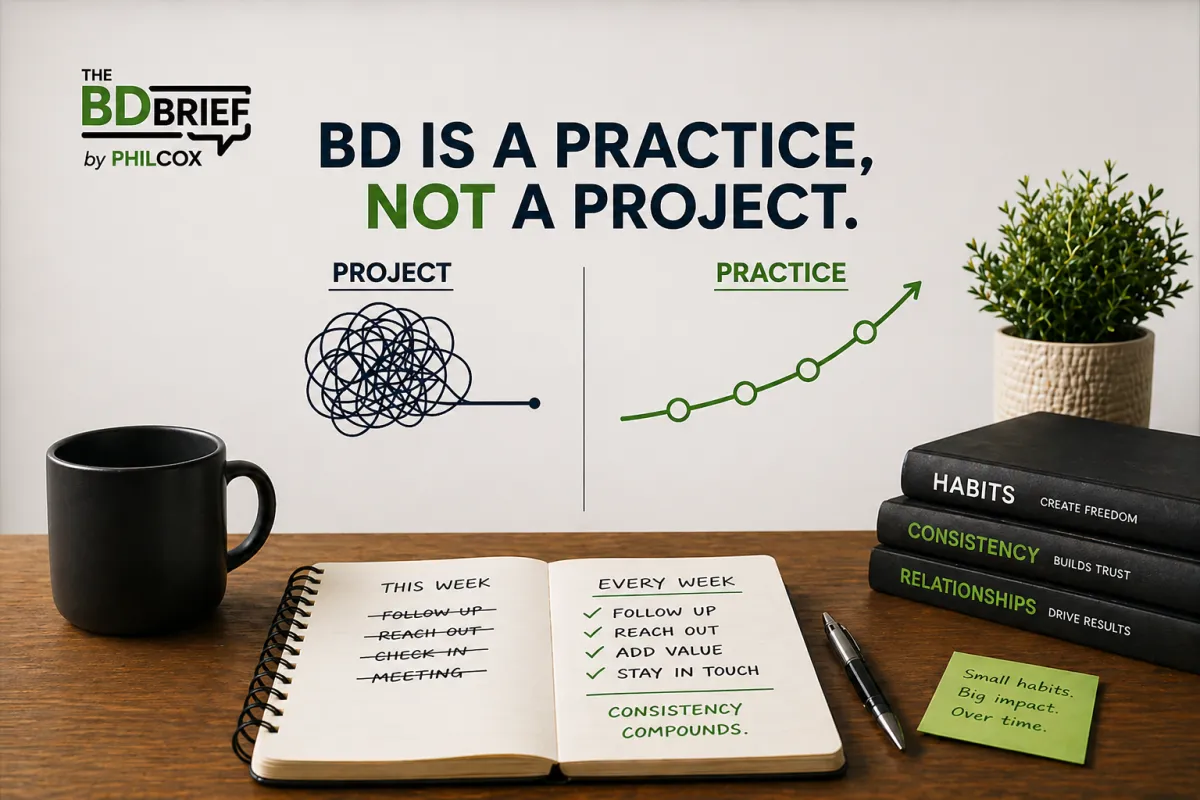
BD Is a Practice, Not a Project
Released on February 19, 2026
It’s easy—especially when time is scarce—to think of business development as something you do rather than something you practice.
A project. A campaign. A short burst of effort.
You set aside time before a conference. You make a quiet promise to yourself that you’ll follow up more deliberately this time. You tell yourself that this quarter, BD will get the attention it deserves.
And for a while, it does.
But then client work ramps up. Billable hours take over. The sense of urgency fades. Business development slips back down the priority list.
This isn’t a failure of discipline or motivation. It’s usually a sign that BD has been framed in a way that makes it hard to sustain.
Projects End. Practices Continue.
In law, very little of what you do well is accidental. Strong drafting skills come from repetition. Judgment improves through exposure. Client management becomes smoother because you’ve handled similar situations before.
You didn’t develop these capabilities by attacking them in short, intense bursts. You developed them through practice—by showing up repeatedly, applying the fundamentals, and refining them over time.
Business development is no different.
When BD is treated like a project—something to “get done” or “clear off the list”—it competes directly with urgent, revenue-generating work. And it almost always loses.
When BD is treated as a practice, it becomes part of how you operate.
Why Habits Matter More Than Motivation
There’s plenty of debate about how long it takes to form a habit. Twenty-one days. Sixty-six days. Ninety days.
The exact timeline matters less than the one point most research agrees on: repetition is what makes habits stick.
Habits don’t form because we understand their importance. They form because an action is repeated often enough to become familiar—and eventually automatic.
This is where business development often becomes difficult. Many lawyers rely on motivation to drive BD activity: a slow quarter, a performance review, a new year. Motivation helps—but it’s unreliable.
Habits don’t require inspiration. They require consistency.
Consistency Beats Motivation
The most effective BD strategies aren't built on occasional bursts of effort. They're built on simple, repeatable actions that become part of how you work.
If you'd like help creating a more consistent approach to business development, let's talk.
Click here to find a time to talk
When BD Lives Outside the Workflow
When BD sits outside your normal workflow, it feels optional—even when you know it isn’t.
That’s when it becomes:
Something you’ll get to after the deadline
Something you’ll focus on once things calm down
Something you’ll restart next quarter
The result isn’t a lack of effort—it’s inconsistency.
And inconsistency is what prevents otherwise capable lawyers from building a reliable pipeline of work.
What a BD Practice Actually Looks Like
A practice doesn’t require large blocks of time or constant activity. It relies on small, repeatable actions done consistently.
In business development, that might include:
A regular time each week for relationship follow-up
A simple, repeatable way to stay visible with key contacts
A consistent approach to conference or meeting preparation
A defined process for turning conversations into next steps
None of these actions are complicated. Their value comes from repetition.
Over time, they stop feeling like “extra work” and begin to feel routine.
Repetition Builds Confidence
One of the quieter benefits of habit-based BD is confidence.
When you repeat the same types of outreach, conversations, and follow-up, you stop feeling like you’re improvising. You know what works, what to say, and what comes next.
That confidence doesn’t come from theory alone. It comes from doing the work often enough that it feels familiar.
From Project to Practice
The most sustainable BD strategies aren’t built on heroic effort. They’re built on fundamentals, repeated over time.
When business development becomes part of how you run your practice—rather than something you return to when time allows—it becomes easier to maintain, easier to prioritize, and far more effective.
That’s when BD stops being a project.
It becomes a practice.
Action Audit
If BD Isn't Working, Ask Yourself This:
Where does BD actually live in my week?
What specifically bumps it off the calendar?
Do I have a defined follow-up process — or am I improvising each time?
Am I relying on motivation… or repetition?
If someone looked at my last 30 days, would they see a system — or bursts of effort?
The answers will usually explain the inconsistency.
You don’t fix BD by trying harder.
You fix it by identifying what’s missing — and installing it.
That’s the shift from project to practice.
If you’re interested in habit building, James Clear’s book, “Atomic Habits” has been on the New York Times bestseller list for over five years straight!
Need Help Turning BD into a Consistent Practice?
If you're looking for a clearer BD plan, a more effective follow-up process, or simply more structure around your business development efforts, I'd be happy to help.
Click here to find a time to talk
Enjoyed this article?
The BD Brief is a free newsletter where I share practical business development ideas, strategies, and tools to help IP attorneys build stronger practices.


